Showing posts with label Salvation. Show all posts

Tuesday, January 27, 2015

Man, I love Brad.

I almost titled this, “Things We Can All Learn From Brad." But the first line was this:
Man, I love Brad. 


At the end, after writing all of this, I still went with "Man, I love Brad."

NB Story: Brad from New Beginnings Church on Vimeo.
And man, I love the living Person, Jesus Christ, who arrogantly, rudely, and inconveniently grabbed a hold of Brad as if to say, “Enough! Your life is done. It is ended. Your life will now be all about ME!” 
Brad may have more understanding of rich theology and perpetual repentance in his pinky than many people have in all their years of church attendance. Here are some things I can learn and contemplate from a small glimpse of Brad’s story. 

1.    August 9th, 1999 —Jamie and I were enjoying the warmth of the beach and ocean two days into our honeymoon—Brad was dead—spiritually dead—unknowingly about to be interrupted and assaulted by the Missional God—as Brad says later “the call of the cross is the end of us.” 

2.     “I thought that God would have no use for a dog like me.” (See Ephesians 2:1-3; 1 Timothy 1:15;) What is amazing about God is that somehow, with guys like me and Brad, through an abundant outpouring of grace, he does still have redeemed plans and purposes in His Kingdom. 

3.     “I ran with a bad group of guys…” 

  • Some may come from a more “cleaned up” background, some may have a better “pedigree” and family tree. But the truth is everyone of us are a “bad group of guys.” (See Isaiah 53:6; Romans 3:10-12, 23; Romans 5:12-14; Ephesians 2:1-3) We’re all much worse than we’d like to think. 


4.     “When you live in darkness, you don’t realize that all that is is the absence of light.”

  • Beautiful...beautiful statement! Read it again. Oh, that each one of us could start each day realizing we have hearts formerly controlled by darkness. And that the only light that changes that is sufficient to completely re-create all things. (1 John 1:5-10)

5.     “The decision to commit suicide was an emotional decision, I think, that contradicted what I had gained in knowledge. And so when I went out there, the thing that stopped me was that God caught my heart up to my mind."

  • Many people struggle with allowing emotions/feelings to dictate truth. They allow feelings and emotions to stir up thoughts that are contrary to truth—especially God’s truth. 
  • Things change for people when they start allowing God’s truth, found in His word, to dictate their feelings and emotions. 
  • For example: “My life is horrible(feeling inside). Everything is miserable (feeling inside). There is nothing to live for (thoughts not based off of truth).  Therefore, based off of those feelings—I decide (thoughts disconnected with actual truth) to jump off a bridge.” You see where emotions have dictated and influenced thinking. Let’s look at the opposite where God’s truth influences our feelings and see the result.
  • For example: “My life is horrible (feeling inside). Everything is miserable (feeling inside). There is nothing to live for (thoughts based not off of truth). But in actuality, no matter how bad I’ve screwed up my life. No matter how bad I’ve hurt others. No matter how horrible I feel or think about myself—I know that even in all my sin and pain—God has forgiveness and mercy for me (truth from God’s word). The Bible tells me not to dwell in anxious, miserable, fearful thoughts (Philippians 4:6-7), but to instead dwell on truth and things worthy of praise (Phil. 4:8). There is something to live for—I was created by God and redeemed and forgiven by Christ no matter how long and how horrible my list of sins could ever be! (Ephesians 4:14-21 truth from God’s word that begins to shift and transform our thinking and the emotions begin to follow) Therefore, since I deserved wrath from God, but was forgiven much, I am brought low. I am humbled. I am amazed at this God and this Savior Jesus Christ! (feelings change from horrible/miserable to humility, awe, and gratitude) Since Christ accomplished salvation for me on the cross—even though I could have done nothing to earn it—I am filled with praise and look forward to living for Him and His Kingdom! (feelings of thankfulness, hope, and love have emerged from God’s truth). 
  • So we see how God’s absolute truth—must dictate our emotions/feelings—not the other way around. (See 2 Cor. 3:18-20; Romans 12:1-2)

6.   “Kind of now that I’ve matured I can look back and kind of smile at the whole thing, because the result of that night was still death. I’m a firm believer that the call of the cross is the end of us. Anything less, and we haven’t really surrendered to the gospel.” 


  • Wow. Does he teach theology at a seminary near here? Does he speak to every single person’s need in understanding what it means to be “Christian.” 
  • In an American culture where we’re taught and told that God saved us because we were so special—here’s a statement that says that in saving us—it was not all about us—it is the death of us. That being a Christian is NOT making God a “useful tool” for my own health, wealth, and prosperity. It is a call to die to self and live for King Jesus. 
  • Dietrich Bonhoeffer wrote, “When Jesus calls a man, He bids him, ‘Come and die.’” Death to self and our old life is a matter of learning to love and trust God. That is the essence of faith. From the outside looking in—friends and family don’t understand the change that happens internally in a person. People think it is a matter of external rules (don’t cuss, don’t get drunk, don’t do drugs, don’t steal, don’t be mean, just be a better you!). Nothing is farther from the truth. Most people think that a person starts going to church because they want to be a “better person.” 

  • There is an assumption that once a person “finds God,” that they now look down on “sinners” or people who still partake of practices that this person formerly did. The truth that Brad understands is that if we have understood God’s salvation provided by Jesus’ death on the cross where He, the perfect innocent Lamb, was slaughtered for all MY SINS as a substitute—that it should ONLY produce immeasurable humility in their own person and awe as they are captivated by Jesus Christ. 
  • From the outside looking in, people often wonder why their friend become, in their opinion, such a radical. “Sure, I think it’s fine if a person wants to better their life and start going to church, but you don’t have to become one of those extremist Christians.” What this thinking misses is their friend’s amazement and worship of of Jesus Christ. They don’t do churchy stuff in order to be better—they don’t abstain from things to earn closeness to God—but instead, in response to what Christ has accomplished for them—a heart of captivation occurs. He becomes everything. This is the surrender Brad now lives out day-to-day. 

7.     “And a year into marriage…and all that fun stuff, I was diagnosed with the same disease that had caused me to rebel, somewhat, from my father. And as I look at it today I think it’s been one of the greatest points of my personal worship. Um, because it made me ask questions that I honestly hadn't really asked. Like, if today is the last time that I’m able to speak, what are the last words I’m gonna say? If today is the last day I’m able to use my hands, what am I using them for? Is it an offering or a consumption? If today is the last day that my brain functions clearly, what am I thinking about? 


  • Not in the plans. This is not what you want to hear your first year of marriage. Notice that Brad says it has brought about worship. That doesn’t mean it was easy. That doesn’t mean it was a light blow. It means that in the midst of weighty news—there is something more luminous and weighty. 

8.     “Um, and it really caused me to focus on that kind of stuff…let’s look at it just black and white, right. The cross didn’t cost us anything right? Nothing. And at the same time if the cross becomes a reality to us…if the resurrection of Christ becomes a reality…if that birth in a manger becomes more than a fairy tale story and becomes a bloody baby being brought into the world that would lead to a bloody cross that would lead to an empty tomb…then I think the cross cost everything.” 

  • It is by grace alone that Jesus came and sought Brad as a young man more dead in his sins and transgressions than he could imagine. So that Brad’s boast could be only in Christ and what He had done. That part is a payment that we could never pay. Like Brad said, the cross cost us nothing initially. Salvation, redemption, reconciliation, atonement, forgiveness of sins was completely and comprehensively bought by the slaughter of Jesus on the cross. The innocent, perfect One, took on the guilt of mankind. Brad is broken knowing he was undeservingly atoned for. Yet, after Jesus gets our captivation, He begins to show us the cost. Salvation free, truly and totally. But sanctification costly and difficult. And both salvation and sanctification supplied by Jesus’ life, death, resurrection, and soon return. 

9.     “So, you know, initially, the fair is pretty cheap. At first, you know, that night that I accepted Christ, it felt like He had paid it all. And as I have become a disciple of Christ, whose desires now lines up with my Father’s desires, it causes me to groan even deeper for my sin. Because to truly follow Christ, and to worship our Father in heaven, I believe it cost everything. It’s not a song. It’s not a poem. It’s not a video interview. It’s…It is about God’s glory. The end.” 

  • Following Christ is increasingly costly. And He is increasingly more glorious. The deeper a person understands these truths—the greater their insight into the contrast between true holiness and righteousness—and the vast gap to their heart’s corruption and depravity. We are wired to want to hear how great we are and how wonderful we are—and there are truly times where words of affirmation, appreciation, gratitude, and encouragement are needed. But our hope lies not in greater view of ourselves nor greater self-esteem. Those lead to pride. Instead, we need a smaller few of ourselves and a greater, higher, more glorious view of Christ! It truly is all about His glory, in the end. Not ours. 

Sankie P. Lynch
www.nbchurch.info
www.nbfamilies.info
sankie@nbchurch.info

Tuesday, November 4, 2014

Hypocrite OR Radical Love?

One of the most common statements that people have about people who profess to be “Christian” is that “they are all hypocrites!” 

That angers some people who consider themselves to be followers of Christ. But it shouldn’t produce anger—but maybe humility. And possibly even lead to an enroute to show people the type of love Jesus would have us show the world. 

When we are getting to know people and they are hostile to “the church” or disgusted by Christianity, it really should not surprise us. It definitely shouldn’t give us an excuse to turn our backs on them. 

  • There are people who truly have been hurt extremely bad by people who are “churchy.” 


  • There are people who are angry at Christianity because they don’t understand why we hold to absolute truths from God’s Word—instead they think we’re choosing which things we oppose on our own compass. 


  • People who have spiritual blindness and who do not understand the Bible cannot grasp, on their own ability, the depths that Christ is in His word. 


  • People see and experience “evils” in everyday situations—therefore it’s difficult to understand why Christians still say God is a “good” God with so much hurt and evil. 


We should expect people to have misunderstandings about our lives and why we’re so involved in the lives of others who make up our local assemblies. But it may be a very true gauge of our hearts if we are not loving to those who oppose us. 

Love should be the overarching goal when we’re dealing with people anyway. Whether we’re joking and playful with people or in serious and sobered conversations—love needs to be the mindset we have and what they walk away with. 

I had a conversation with a professor at USC while we were at a summer project in L.A. who kept pressing that we Christians were not only hypocrites, but also frustrating because we were trying to tell people they were going to hell. 

I answered by saying, “If I am one of those radicals who actually believes that people are facing the wrath of God, in their sins, if they are not living for Jesus—if they are not changed by the news of forgiveness and reconciliation that He has provided—If I said I believed that but then never told you about it—wouldn’t that prove to be the most unloving thing I could do?”
But If I tell you these things that I believe are true—a message that is eternally significant—wouldn’t that move me from the category of hypocrite to “true friend? I would think that might be the most radically loving thing I could do for you.” 
Sure, you may still disagree or reject what I tell you about Christ. You may choose to believe there is no God or no God worthy of submitting your life to. But if I sincerely believed this—as in staking my life on it for this lifetime and the next—and I kept that truth from you—now that would be a hypocrite.”

This guy was a philosophy professor at USC—so needless to say he thought my beliefs were silly. But he responded in saying that he had never thought about it from that perspective (and again, this was a philosophy guy!). 

The point is this: Jesus said, “As the Father has sent Me, so I am sending you.” 
In another place Jesus said, “Behold, I am sending you out as sheep among wolves.” 
Our words and actions are to be loving whether they receive them or not. Jesus was mocked and 

We should not be surprised at all when people around us are indifferent at best, and hostile at worst to our beliefs, lifestyles, and commitment to Christ. 

Jesus clearly told us that ravenous wolves would be attacking us as if we were defenseless, weak sheep. He already told us that. No surprises then. 

He told this warning while at the same time saying, “Love one another, as I have loved you. In this way the world will know that you are My disciples, by the love you have for one another.” 

So not only are we to bear with, have extreme patience, and put up with attacks from “wolves” around us—but we’re to still “love” people when they don’t even see the harm they are causing. 

People may not even receive the love we are trying to sharing. Due to hardened hearts, hatred, and complete spiritual blindness they are incapable of it. We should be broken and saddened by their state of being. 

We need to embrace that we are hypocritical and will fail people. We also need to engage with difficult people in showing the love of Christ with people who are very hostile to the message we’re sharing. We need to share the radical love of Christ with people who radically oppose it. We need to be a people known by this same type of radical love. 

Sankie P. Lynch


Tuesday, April 22, 2014

Once Dead…But Made Alive Through Christ

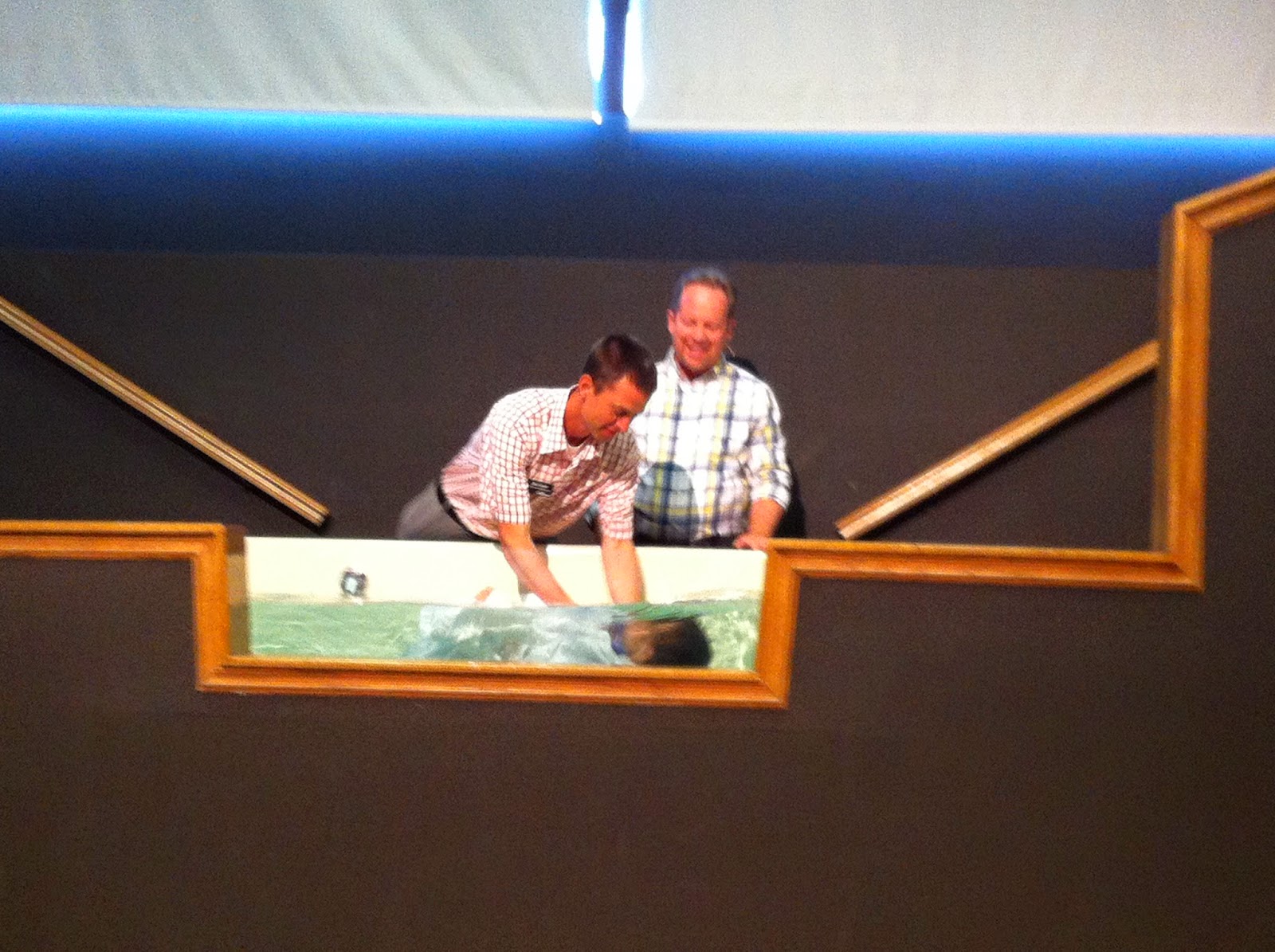
This past Sunday was one of the most incredible experiences of my life as a father. Getting to baptize our oldest son Sankie will remain as one of the most special events in my life. I hope to be able to do the same with Owen, Jackson and whoever this next one is!
Me baptizing Sankie II Easter Sunday


Jamie and I have prayed and prayed and taught and corrected and disciplined and trained and yet—none of that earns salvation for a child. So this is not a story of how great we’ve been as parents which equated to a kid getting to heaven. Instead, I hope you hear the screaming question of why so much grace? 

If we’re not careful, we begin to think that all our good efforts in parenting should bump us up on the list toward our children being saved. Now of course, we never verbalize that or allow ourselves to admit it. But it may be there nonetheless. Across the spectrum of evangelicalism (and cousin Charismatia) this expectation of “teaching them diligently” (Deut. 6:7) being completed in some equation to salvation may be seen in our frustrations or our impatience with our children. It may be detected in our desire to pridefully exhibit the perfect family image with quiet, still, smiling, clean, nicely-dressed little pictures of Godliness. God burst that bubble for us with child #1 in week #1—and continues to solidify with further examples! It may show up secretly as we jealously desire people to honor us and praise us as spiritual families. It may be seen with our contempt as we secretly point our finger in God’s face reminding Him of all we’ve “done” for Him with our children and service in the church. 

Again, none of that impresses Him on a resume for salvation. All our attempts at good parenting are also “as filthy rags” (Is. 64:6) when it comes to earning merit or God owing us something in regards to salvation. 

So, standing there looking down at the baptism tank as the boys were preparing for their time I had a screaming thought blaring in my head…”WHY?” 

Testing the waters
Why so much goodness and grace poured out on a little guy who deserves nothing but wrath? 

Why so much mercy for seven years of rebellion against God’s commands? 

Why would God receive my son unto salvation when literally billions of people across the planet have not heard the name of Jesus nor the salvation He offers? 

Why so much love and grace poured out on such unsuspecting souls? 

Baptism screams at us the reality of God’s amazing grace. Ezekiel 37 tells the ridiculous story of dry bones miraculously being brought back to life as God is showing off His infinite power and supremacy above all things. I call it ridiculous because it is ridiculous for man to believe in spiritual rebirth (“born-again”) if not for a God who commands it and it happens according to His word. God is the only one who can bring dead souls to eternal life. God is the only one who has the power to make all things re-created in His Son’s likeness. Baptism should halt us and help us to think through and appreciate the grace of God in the great news of the gospel story. 

Sankie, Chandler, and Noah
All the teachings, prayers, lessons, Faith Talks, Faith Walks, God-moments, and Bible readings do not save. They bring the good news of the gospel into the environment of the child. God, the Holy Spirit, breathes new life as the words of the gospel are articulated in the child’s hearing and sight. God is the only one who saves. 

Baptism is a beautiful picture meant to show that a person who was once “dead in trespasses and sins,” (Eph. 2:1) has been brought into eternal life through what Christ accomplished on the cross. 

A person formerly facing God’s wrath as rebels to His will now reconciled and adopted as a child of God. Where formerly they were lost in darkness pursuing their own way—now brought into the light. Where formerly they were guilty—now because Jesus took on their guilt—they are now pronounced “NOT GUILTY!” Solely because of what Christ did on the cross. 

Once the Holy Spirit gives understanding to these truths and brings repentance and faith, the person is re-created internally with a new heart that desires to follow God’s law. This is the internal heart change wrought by the Holy Spirit of God. 

Baptism is an outward expression proclaiming the great news that this person has been forgiven of sins (1 Pet. 3:18; Col. 1:13-14), justified by Christ (1 Cor. 6:11; Rom.8:30; Rom.5:9; Rom.5:1), adopted as children of God (1 John 2:28–3:3), and reconciled completely to God (2 Cor. 5:17-20). 

Baptism does not save at all. There is nothing salvific about baptism. The water of baptism does not wipe away or wash away sins. Sins are completely and entirely forgiven by Jesus’ death on the cross. Baptism is not the “second requirement” of salvation. Salvation is by grace alone through faith alone in Christ alone through His cross. There will be many people in heaven who were not baptized in water. There will also be many people in hell who had been baptized in some manner while on the earth. But baptism does not save. 

Baptism is one of two ordinances given to the church (the other being the Lord’s Supper) to be performed repeatedly by local assemblies of believers to proclaim the death and resurrection of Jesus to the world around us until He returns. Individuals who put their trust in Christ’s atoning work on the cross are commanded to be baptized afterwards. 

So what about baptizing children? 
There has been much discussion with varied stances concerning how appropriate it is to baptize young children—especially children under the age of ten. Now for many of you, that may be “new” news to you. Some people are outraged when I even bring up the fact that people have questioned baptizing five and six year-olds. Over the last sixty years, the number of baptisms do not equate with the number of people who continue to participate in church. The growing concern has been that many people make “false professions” of faith either as a child at a young age or as a teen-ager. Over time, pastors and theologians have asked if baptism gives people a false sense of security or a false belief that they are going to heaven once they are baptized. That problem is not solved by taking away the water of baptism, which is in accordance with God’s word. That problem is a much larger discipleship problem throughout the church. 

Some churches have decided they would set a certain age as the first eligible age for baptism (for example 12 years). The thought is that younger children (5-10 yr-olds) will have more time to sort of “give evidence” to their salvation. Everyone knows that it’s very difficult to see how much “lifechange” truly occurs in a five or six year-olds life. They don’t turn from drug abuse, sexual immorality, and debauchery at those ages. Some churches have even set the number as high as sixteen. Many of those churches who set numbers have gone back and removed the limitation because, Biblically speaking, you will become more pressed to show how forcibly delaying and restricting baptism to certain ages is more in line with orthodoxy. The Bible seems to point to more immediacy. Parents also become very frustrated when a child makes a profession of faith at six or seven and the church then tells them they have to explain to their child that they have to wait six more years for baptism. Again, you may find yourself justifying how you are a stumbling block to a child’s desire for obedience in baptism!

Matt baptizing Chandler Easter Sunday
I personally appreciate looking at baptism as an outward step of obedience in accordance with Scriptural commands (Acts 2:38; Matt. 28:18-20). I believe we can look at a younger professing believer’s intent and desire for obedience through baptism to be considered much like a “letter of intent.” For all their present understanding and ability, they believe God has saved them from their sins and to the best of their ability they desire to live for Jesus in obedience to His Lordship. Baptism is their first public proclamation that they love Jesus and understand He saved them in His death and resurrection. As stated many times, “from dead in trespasses and sins, raised to walk in newness of life,” (Eph. 2:1; 2 Cor. 5:17). Baptism is the visible outward picture of what has happened internally in the heart. 


So, yes it is hard to discern. But if we believe that that first initial “response” or some sinner’s prayer at the front pew of a church is all we’re banking on, then we are the ones needing more help. Is there follow through and continuous discipleship going on before, during, and after a profession of faith is made? Are we teaching them what following Christ looks like and how it is lived out—or are we finished once they pray the prayer? Again, this is a much deeper problem of discipleship within the church at large. 

I do believe churches have done much harm in having people walk an aisle—asking people to get baptized when they’ve never yet asked them if they understand the gospel and salvation. 

I’m extremely encouraged to see many churches implementing a process or a class for younger children to go through to communicate, to the best of their ability at that age, what they believe has happened to them in salvation, what they believe the gospel message is, and what baptism is and is not. At least someone is asking them 1) if they’ve been saved and 2) what they believe that means. Bethlehem Baptist Church (Children Desiring God) has a helpful tool titled, Preparing Young People for Baptism. 

Steve baptizing Noah Easter Sunday
Our church, New Beginnings, uses Lifeway’s resource, I’m A Christian Now! We have a couple, the Bowman’s, who teach through six weeks of the class repeatedly clarifying the message of the gospel, what it means to agree with God about our sin and need for Him, what it means to believe in the true offer of salvation in Christ, and what it means to confess our faith in Christ. This little book has some simple truths about baptism itself as well as Communion and other important truths about the church. There is also a second book that follows up after their baptism to help them learn how to follow Christ. 


We have added a time at the completion of this class where I meet with the parents and the child desiring baptism. The six weeks leading up to this are extremely beneficial for being able to articulate their beliefs as well as clearing up any confusion they have on any number of things. I am able to hear from the parents their own assessment of the child’s profession as well as whether they’ve seen marked “Godly sorrow” as described in 2 Cor. 7 that results in a repentant heart. Again, we cannot judge hearts on salvation. We miss it even when we start inspecting fruit. But this is a good step that doesn’t postpone those desiring obedient baptism for five to seven years while at the same time providing a time of clarifying gospel-fluency and understanding of personal salvation. 


Sankie P. Lynch
Pastor of Families
www.nbchurch.info
www.nbfamilies.info
sankie@nbchurch.info


Tuesday, April 15, 2014

SEDER—UP !

For centuries, Jewish families have practiced the Passover Seder. The Passover Seder celebrates God’s faithfulness in freeing the Israelites from their slavery in Egypt. God had commanded His people to retell the story of God’s salvation and deliverance from Egypt. 
Of course, we understand that God's ultimate freedom from slavery to sin and our beautiful salvation was completely accomplished by Christ's atoning work on the cross. 
The boys opted for the "shirtless" Seder. 
“You shall tell your child on that day, saying, ‘It is because of what the LORD did for me when I came out of Egypt’” (Exodus 13:8). If you remember the story of the Exodus, Moses had been told by God to go to Pharaoh and tell him to “Let My people go.” But Pharaoh continued to refuse. Eventually, God sent ten different plagues ending with the death of the first-born in all the homes in Egypt that did not have blood covering their door. This story of salvation, where God spared those covered with blood became known as the Passover. 

After Pharaoh and all of Egypt woke to find their first-born dead—as a result of their failure to listen to God—Pharaoh told Moses to take the Israelites and leave. Moses and Israel fled quickly. Pharaoh immediately changed his mind and wanted the Israelites to remain as slaves to Egypt. So Pharaoh’s army pursued them. 

Israel saw God’s salvation and faithfulness again as Israel was pinned up against the Red Sea. God parted the Red Sea and allowed Israel to through on dry land. As Egypt’s army pursued them between the divided sea, after Israel’s last families passed in to safe territory, the waters came crashing down on the army. God had provided salvation again for His people. 

This OT story of God’s salvation points to God’s ultimate salvation from slavery and sin that was brought about by the finished work of Christ on the cross.

Last night our family participated in a Seder with a meal together. You can download or print off this special Easter Faith Talk outline from our church website by clicking here. It's listed as a tab right above the title of the video as "Holy Week Faith Talk." 

Here’s how ours went down:
( And to encourage everyone—our boys were out of control tonight—we got started very late—and this was something we were trying for the first time. Some elements went well even with very playful attitudes. )

We started by having them wash their hands. 

The Scriptures listed on the left side of the page go right along with the Seder plan. You can simply read the section on the right and then go to the matching Scripture on the left edge of the page. 

We didn’t have lamb—but went with pork tenderloin (Neo-Kosher). We simply enjoyed this aspect. God gives us things to simply enjoy. We could have lied to them and told them it was a “sacrificial lamb,” but we passed on the deceitful route for our first Seder. 

We used a simple green vegetable—the Hebrews would call it “green beans,” (pronounced grrieeen beans). They represent spring and new life. 


We had salt water in a glass to symbolize and talk about the slaves’ tears and what that was like for them to live in while in Egypt. Surprisingly, the tears discussion kind of captured their attention. 
We explained more about slavery and how unjust it was because people are made in God’s image. We also made a quick connection to slavery to sin and the type of slavery they experienced in Egypt and how God had promised a future land without slavery. 

I thought we had horseradish at home—but didn’t. We were going to use that as the “bitter herbs” to talk about the bitterness of living in slavery. Since we didn’t have a true bitter herb, we improvised and used some almonds covered with a bitter chocolate covering. It worked perfect. We told them to put their tongue to it (it was very bitter if you barely tasted it). Then we all put it in our mouth and kept it there without chewing it up. It remained bitter for about half a minute. Then when we bit into it—it became sweet as you broke through the chocolate. We used that to show how God takes bitter, painful things in life (slavery, sin, the cross for Jesus), and brings something great and beautiful and redeeming. 

We explained God’s salvation for Israel in the Passover as well as His salvation at parting the Red Sea. We then had some wafers/crackers with sea salt on them to talk about the hasty leaving of Israel once the ten plagues had been unleashed on Egypt. 

We also had red juice to celebrate God’s salvation at four different points in our story. 
(Remember, the key is not exactness in details of food elements—but a focus on being thankful to God in His faithfulness in redemptive history leading up to the ultimate salvation in Christ’s death and resurrection.)

We also read a “blessing” over the boys from Ps. 121:5-8 and prayed. We got this from the small booklet A Father’s Guid to Blessing His Children, by David Michael and Children Desiring God

We closed by doing the “Lentil Lights” (I think thats what its called) where you turn out the lights and light seven candles starting on Good Friday. The house is completely dark except for the light from the seven candles. This really grabs the boys attention. We’ve done this one for the last few years and every year I’m amazed at how focused and serious the boys get as we talk about the week leading up to Jesus’ death on that next Friday. Each night you blow out one candle…six remaining, then five, then four, then three, then two, then one. And finally you blow out the last candle on the Friday respectively close to Easter. It’s complete darkness. 

The darkness reminds us how dark this world truly would be if we were left in our sins and if there was no Jesus and no resurrection. The darkness reveals how dark sin really is and how it separates us from God in a way we don’t usually like to look at. Then Saturday night you leave the candles still out. Then Sunday morning, you wake them with all seven candles lit and burning brightly again (or one large candle). He is risen! The true light of the world who reflects His glory throughout the world! His work on the cross sufficient and successful!

Our boys have loved this every year. We let a boy blow out a candle each night. 

Now remember, this started out with a rough crowd! The boys were exceptionally loud, bouncy, and laughing at everything they were saying. They really became focused as we started in on each element of the Seder so I would strongly suggest for others to do this with their family. It can really build up to the beauty of what Christ accomplished on the cross and through His resurrection. 

May your week be consumed with thoughts on this captivating Christ, His cross, and His resurrection!

Sankie P. Lynch
www.nbchurch.info
www.nbfamilies.info
sankie@nbchurch.info


Tuesday, April 8, 2014

T4G (Together 4 The Gospel) & The Pastor in the Public Square

This is "Geek Week" for me. We all have things that we geek out on. For some it's hunting and fishing. For others its Star Wars and Battlestar Galactica. For others its sports teams. Earlier in life I thought that was going to be what I spent most of my free time enjoying. Somehow, for me, this ended up being rich theological contemplative thought. I don't know how this happened. It was never hunting or fishing. It was never video games. It was never science or math. It used to be sports. So how did this happen to me? Why me??

I was talking with a guy a few weeks ago at church and it was the first time we had ever really got into any kind of conversation. We are new at New Beginnings and his family is fairly new and checking out the church. Within one minute he began to tell me some of the books that have influenced him the most over the past decade. He rattled off four or five books. Excitedly, I rattled off three or four similar books written in the same vein. We were both caught in a moment. His wife interrupted our newly discovered bond of brotherhood with "Hey, you guys are totally geeking out. About books! I'm going to pick up the kids to leave you two alone." 

That was embarrassing.  We were caught. Like two young boys caught giddy over their recently opened video game. So this week I'm geeking out with 8,000 other men who understand this odd fascination. 

As I write this I’m sitting in a parking garage 3 floors under the ground in downtown Louisville at the KFC Yum! Center. Yesterday was the first day of a class I’m taking at Southern Seminary titled “The Pastor in the Public Square.” This morning is the first annual Conference on the Council On Biblical Manhood and Womanhood. This afternoon the T4G Conference begins. It’s four days packed with some brilliant thinkers, pastors, and theologians. There’s several main sessions with many breakout workshops between those sessions. 
The theme of the larger conference, T4G, is “The Unashamed Gospel.

The class, “The Pastor in the Public Square” has the purpose of equipping and challenging pastors to think through the nature and degree to which they should engage in cultural issues. 

Some of the cultural issues facing Christianity are not new to the fight—though some may think that’s the case. As President Al Mohler has been so consistently arguing for awhile now, the culture we greet in America is growing more and more toward first century Christianity. 

So the main issues facing believers may seem to be more hostile than ever, but that’s not looking through the lens of church history. In the first century, Christianity faced rampant paganism, idolatry, multi-faceted sexual immorality, breakdown at the core level of marriage and family, slavery, abortion and child sacrifices, governmental abuses, social injustices, and rare religious liberties. That was the predominant culture of many of the cities that Paul faced as he entered in bringing the hope of the recently crucified Savior of the world. 

Some questions being processed are:
What has changed so that cultural issues are now chasing down pastors in order to confront them in the public square? 

Are we currently in a culture war? —Or has the culture war already been lost? 

How should Christians and Pastors engage in cultural issues in the public square? 

How do followers of Christ engage in culture and hold to absolute moral truths from the Bible when you’re immediately labeled as an intolerant bigot? 

If religious liberties continue to be lost on the judicial and legislative territories—how do Pastors lead their people to still engage on ethical issues? 

If religious liberties continue to be lost—how are believers to protect their families and churches in ever-increasing attack? 

These are difficult and complex spiritual issues that have thousands of implications on practical daily choices and living. We need to contemplate and think deeply about how the gospel of Christ can be clarified in a way where our love is seen through engagement, gentleness, humility, service and truth. We need to be careful not to engage in order to “prove we are right!” but instead because Jesus Christ and His cross is the greatest and only hope this world still has and the only hope in all eternity. 

Sankie P. Lynch
Pastor of Families
www.nbchurch.info
www.nbfamilies.info
sankie@nbchurch.info


Thursday, January 23, 2014

Keep the Faith and Stay the Course

Here is a quote from Sankie's blog on Tuesday: "Have a plan. Implement the plan. Remember the plan is a process over time. Be faithful to the Person of Christ and the process He’s got your family in."


This is similar to what I have to talk about this week. In sitting through our first session of our latest Men's study on RISK, I am listening to our small group discussion and consistently hearing "stay the course".

Kenny Luck, the author of the RISK study mentions the story of Chuck Yeager. "Chuck Yeager was the famous test pilot who was the first man to crack the sound barrier by achieving supersonic speed. As his plane increased its air speed to a subsonic level just before the breaking of the sound barrier, the aircraft experienced significant turbulence. Likewise, I believe something similar happens to us spiritually as we increase our loyalty to Christ and take more aggressive action on His behalf."


If Chuck Yeager had decided that when the turbulence got so violent, to back off the accelerator, he would have never broken the sound barrier. He would have stopped short of achieving his "plan".


As we lead ourselves in our own spiritual journey and as we lead our families spiritually, "remember the plan is a process over time", so "keep the faith and stay the course."


Matthew 14:22-31
22 Immediately He made the disciples get into the boat and go ahead of Him to the other side, while He dismissed the crowds. 23 After dismissing the crowds, He went up on the mountain by Himself to pray. When evening came, He was there alone. 24 But the boat was already over a mile[h] from land,[i] battered by the waves, because the wind was against them. 25 Around three in the morning,[j] He came toward them walking on the sea. 26 When the disciples saw Him walking on the sea, they were terrified. “It’s a ghost!” they said, and cried out in fear.
27 Immediately Jesus spoke to them. “Have courage! It is I. Don’t be afraid.”
28 “Lord, if it’s You,” Peter answered Him, “command me to come to You on the water.”
29 “Come!” He said.
And climbing out of the boat, Peter started walking on the water and came toward Jesus. 30 But when he saw the strength of the wind,[k] he was afraid. And beginning to sink he cried out, “Lord, save me!”
31 Immediately Jesus reached out His hand, caught hold of him, and said to him, “You of little faith, why did you doubt?”


Don't doubt that you can lead yourself and your family spiritually. If Peter would have just kept his focus and faith in Jesus, he would not have begun to sink. If Chuck Yeager would have taken his foot off the accelerator he would have never broken the sound barrier. But guess what? Peter did walk on water and Chuck Yeager did break the sound barrier.


Fix your eyes on Jesus instead of the "strength of the wind" that Peter saw and that made him afraid. You can do it! Stay the course and keep the faith.


Terry Langenberg
TwitterTheLangenberg
FacebookTheLangenberg

Wednesday, January 15, 2014

Plastic Jesus

Several years back Courtney and I were at a conference in California.  During some off time we were walking around in some downtown area when I saw this figurine in a shop window.  I told Court we had to go in and get it, when she told me it seemed offensive (often my voice of reason).

As I looked over this "Answer Me Jesus" I thought about how this could be taken so so offensively.  But then another idea hit me... Why is this $15 plastic statue so offensive?  Shouldn't the fact that many of us make Jesus just that, a plastic jesus, in our lives be what's really offensive?  Why should we be mad at some guy, who probably doesn't know Jesus as messiah, just because he sells a novelty item.  The real anger should be felt by those of us who have belittled our savior in our own lives... Making Jesus fit our ideas and agendas!!

I wonder... Is your Jesus 'Plastic'!?  Here's some Plastic Jesus examples:

#1 Answer Me Jesus... Have you shrunk your relationship with Jesus to merely answering trivial questions about your life?  Should I date the guy?  Did I have too much to drink last night?  Was that really a lie that I just told or good stewardship?  Should I super-size it?

#2 Bobble Head Jesus... Have you even stopped asking Jesus open ended questions?  Do you simply want your Jesus to give you a 'Yes' to whatever you are wanting at that time?  Jesus, I totally had a right to blow up like I did, right?  I don't have to answer to anyone else about my happiness, right?  Surely I'm not at any fault for this argument?

#3 Dashboard Jesus... Have you moved past seeking any advice or reassurance but you do know the importance of having Jesus with you no matter where you go?  Jesus, I don't really want you to talk but I love that you come with me no matter what.  I don't need your opinions or JUDGEMENT just rock with me man.

#4 Toy Jesus... Did you keep moving until you left him behind?  I'm pretty embarrassed that I used to talk to you jesus.  I've grown up and don't really need you coming with me throughout my day and definitely don't need answers from something so out of date.  In fact, I'm not really sure where I even put that jesus?

#5 Baby Jesus... I'm a CEO now (Christmas and Easter Only)!!  This whole church thing isn't what jesus wanted but I'll come occasionally to appease the family.  Though this religion is just a set of superstitions it is supported by a good teacher but even he wasn't perfect.  Jesus is just a loving son who wants everyone to be happy.

Would you do me a favor... would you take 2-minutes right where you are and ask yourself: has my Jesus become plastic in my life?  Would you be so bold to be gut honest with yourself?

I recently have had a reality check to where I have been.  My Jesus knew grace and truth but was cool with giving me the extra grace and even mercy, even when I didn't seek Him out.  I had put my Jesus on the shelf and essentially left him there for a few months.  Sure, I would pass-by occasionally and be reminded it had been awhile since I talked with him and though I felt guilty I really didn't have the time to stop.  I was thankful He was still out for all to see and be the example for my kids but we knew he was a forgotten about figurine just collecting dust.

Today, I'm thankful for the gospel again.  The gospel is good news and redemption for me and you EACH DAY!!  Jesus came to be more than a plastic jesus but instead a real authentic relationship.  And the coolest news... He loves us too much to let us keep going without opportunity of knowing what that can be like, He provides a New Beginning each and every day for those who are willing (2 Corinthians 5:17)!!

Are you willing to trade in what you've made jesus and accept instead what He is (a real relationship)!?  Are you ready to live for a creator that died for his creation not because you have to but because you want to!?

May we have the courage to ask ourselves the real questions that have been lingering in our hearts and minds.  May we be honest with ourselves and our family about where we've been.  May we lay our lives down because You first laid Yours.  May we be the example God has called us to.  May we pursue Him so we know how to lead our families.  May we find the real Jesus today...even if it's all over again!!    

The Bergs

**Follow Jeff (Family Pastor of High School), also known as "surgeberg" on: FacebookTwitter & Instagram